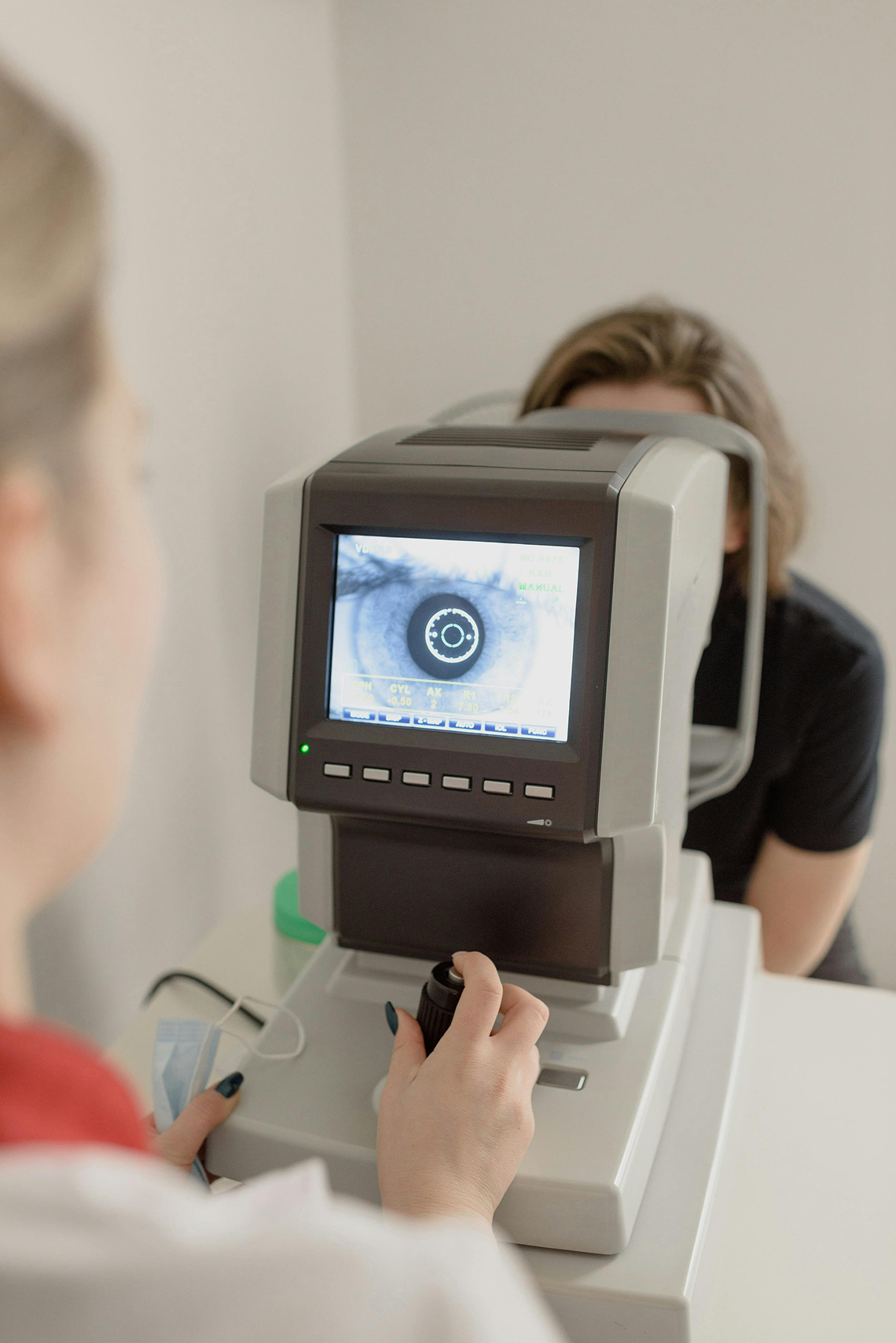
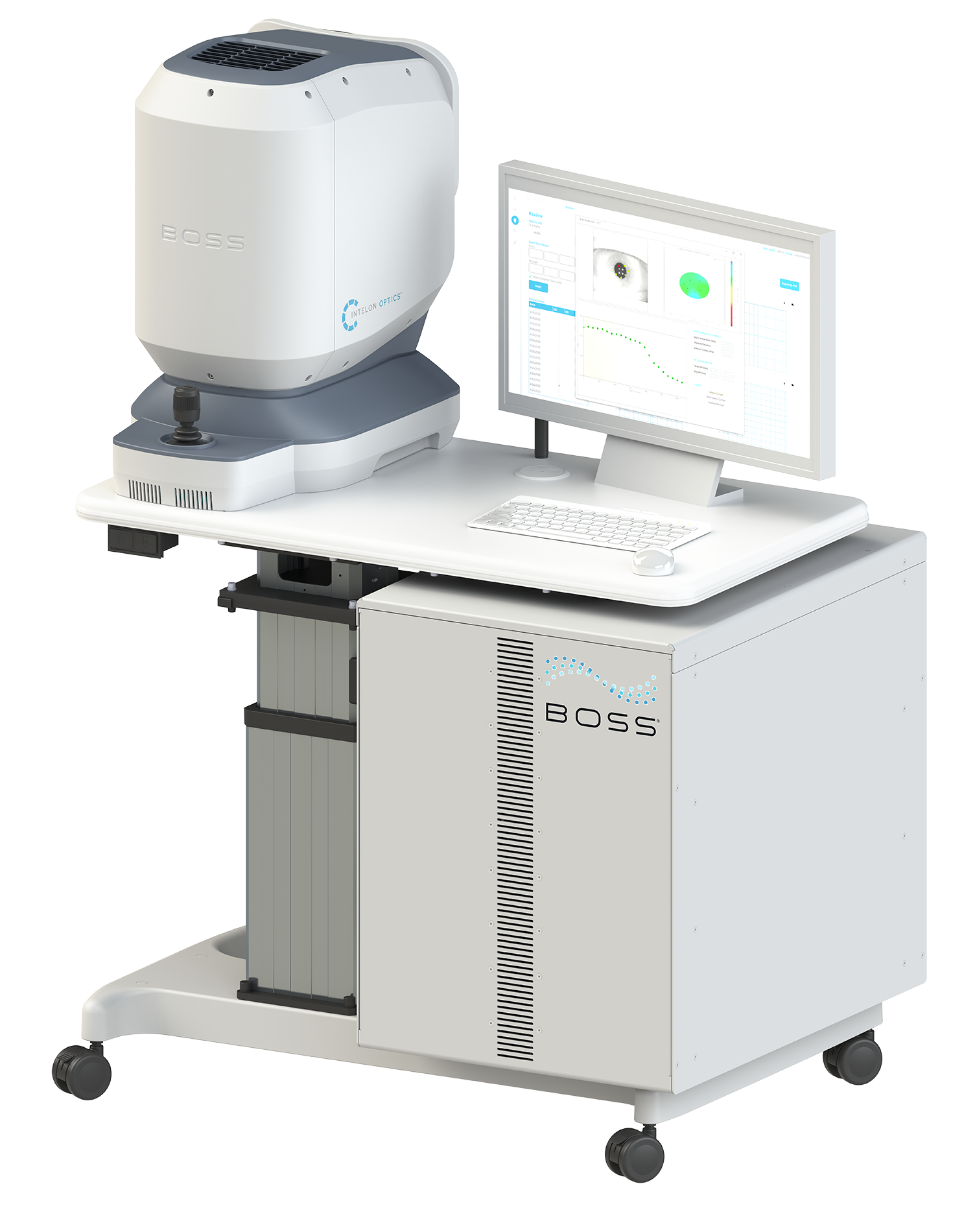
Intelon Optics introduces BOSS®, the first commercially available CE-marked and FDA-cleared Brillouin non-contact ophthalmic scanner to measure ocular-tissue biomechanics in real-time high-resolution 3D.
Enables fast and easy non-contact scans of the cornea and crystalline lens via automated optical scanning.
Adds an extra dimension of biomechanics to complement traditional tools for a more comprehensive assessment and helps improve treatment decisions and early diagnoses of eye diseases.
Supported by over 40 peer-reviewed publications exploring the use of Intelon's technology in ophthalmic research and clinical studies.
CLINICAL APPLICATIONS
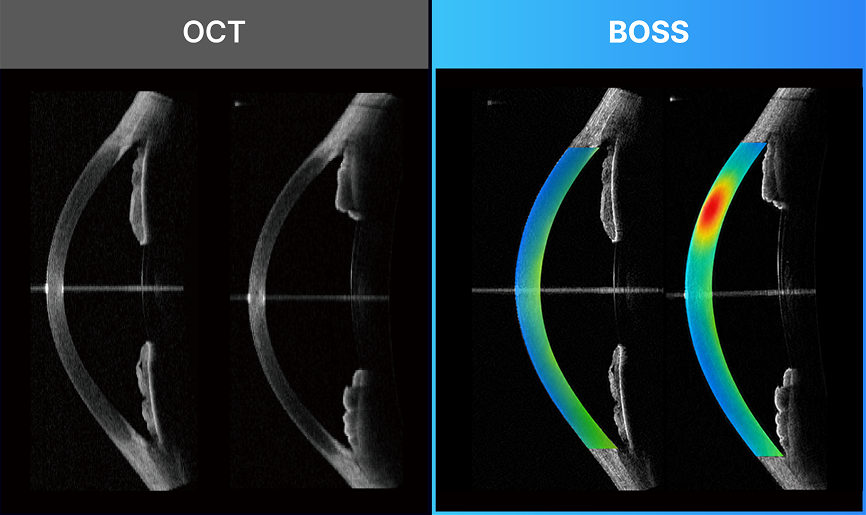
BOSS® provides insight into subtle biomechanical changes in ocular tissues not evident with OCT alone.
Such data has been explored in published research for potential applications, including:
Investigating early biomechanical changes associated with corneal disease,
Supporting screening/optimization for refractive surgery planning,
Evaluating corneal crosslinking protocols in clinical studies, and
Assessing post-operative biomechanical response after cataract surgery.
DATA ANALYTICS
BOSS® AI offers advanced analysis of biomechanical data, supporting clinicians with additional insights during treatment planning. In an internal feasibility study, use of BOSS AI data in refractive surgery planning showed a potential improvement in treatment planning accuracy. These findings are preliminary and not intended to represent established clinical outcomes.
ACADEMIC ARTICLES RELATED TO BOSS®
Intelon Optics developed BOSS® over the last decade with top universities and clinics; there are now 45 peer-reviewed articles in ophthalmology covering Intelon’s Brillouin technology. Research indicates that biomechanics adds an extra dimension to improve clinical outcomes. Click the button below to see a complete list of peer-reviewed ophthalmology articles related to BOSS® technology.
Where to buy
What the experts say

Dr. Jiwon Jeong
Medical Director, Fatima Eye Clinic, Changwon City Seven
I have been waiting for Brillouin microscopy to be commercialized for many years. This is because the measurement of corneal stiffness using Brillouin scattering can measure the inherent stiffness without deforming the cornea or direct contact. The BOSS system can make the stiffness map of the cornea by measuring the local stiffness of the cornea in several different areas. By doing this, you can find out at a glance which part of the cornea is weak and which part is strong, and you can continuously monitor the change. It is very attractive to measure the corneal stiffness of the cornea directly and accurately. We can know the risk of the keratoconus in advance and to know the progress of the disease more accurately. Before the refractive surgery, we can not only rule out people with weak corneas, but also predict the risk of keratoectasia after the refractive surgery. In patients with glaucoma, BOSS will help us measure the intraocular pressure accurately, and if we can measure the stiffness of the lamina cribrosa of the optic nerve in the near future, we can predict the progress of glaucoma. If the stiffness of the sclera is measured, it can also be used as a predictor of myopia progression. As such, the BOSS system using Brillouin shifting will be very helpful in disease research by measuring the stiffness of each part of the eye.

Dr. R. Doyle Stulting, MD PhD
Director of Corneal Disease & Research, Woolfson Eye Institute, Atlanta, GA, United States
It gives us an ability that we didn’t have before to measure the strength of the cornea. We hope that BOSS will be able to provide an earlier diagnosis… and a shorter pathway to the evaluation of newer procedures. It will become a routine screening instrument.

Prof. David Touboul
Head of Corneal & Refractive Surgery, Bordeaux Hospital & University, France
The study of corneal biomechanics has always been a challenge in ophthalmology, opening the door to a deeper understanding of numerous fields of application, such as: the assessment of intraocular pressure, a better understanding of glaucomatous pathologies, the evaluation of corneal stability factors or the triggering of corneal ectasia, the prediction of early signs of endothelial failure or the biomechanical repercussions of subtractive and incisional corneal surgeries. Under in vivo clinical conditions, the ophthalmologist has no high-performance tool for truly characterizing the biomechanical properties of the cornea. In the field of elastometry, dynamic measurements made by palpating the tissue are unfortunately a source of significant measurement and observation bias. For example, corneal indentation palpation technologies, using a calibrated air jet, only allow an approximation of certain biomechanical characteristics, partially included in the hysteresis cycle (ORA), without assessing the absolute hardness of the tissue. Physical values derived from the speed of displacement of the corneal surface (Corvis, OCT elastography), do not provide a true indication of the physical hardness properties of tissue components. Dynamic elastography, based on analysis of shear-wave displacement velocity, would be promising, but is unfortunately difficult to implement and is not yet available for clinical use. Brillouin microscopy relies on a robust correlation between the molecular response of matter to exposure to an electromagnetic field. A coherent, monochromatic light beam (IR laser) is focused onto the area to be probed, and the back-scattered light is analyzed by a spectrometer. Examination of the emission spectrum reveals subtle variations around the frequency of naturally backscattered photons, a phenomenon known as the “Brillouin shift”. The latter turns out to be directly and physically correlated with the modulus of elasticity of the material being probed. By scanning the laser point by point in 3 dimensions, it is thus possible to map the hardness of the cornea (but also of the lens), without having to macroscopically stimulate the tissue during palpation. The stimulation at the origin of this molecular signal is the result of the natural molecular vibrations of the tissue observed in in vivo conditions. It is therefore an extremely precise technology, but also very demanding in terms of measurement conditions. All the know-how of the Intelon Optics team is put to the challenge of transposing this metrological information into corneal maps capable of providing clinicians with relevant information for patient management, through the performance of the BOSS spectrometer. We are proud, at the National Reference Center for Rare Keratopathies at Bordeaux University Hospital, to have acquired this technology, which we believe represents the only commercially available method truly capable of measuring the intrinsic biomechanical properties of corneal and crystalline tissues in clinical practice. There's still a lot to learn about positioning and optimizing the measurements obtained by the Brillouin microscope, but it's an exciting collective adventure that will probably one day lead to major therapeutic advances.

Prof. Anders Behndig
Umeå University Hospital, Sweden
The Intelon BOSS will add a new tool to our diagnostic arsenal in keratoconus. A combined evaluation of the corneal dimensions and its biomechanic properties will likely be the future routine when devided who to treat or re-treat. Other possible applications can be evaluations prior to corneal refractive surgery, to reduce the risk for iatrogenic ectasia.

Dr. Alexander Angelov
Chief Research & Medical Director, Resbiomed, Sofia, Bulgaria
The Brillouin Optical Scanning System, or BOSS®, is an irreplaceable tool in the eligibility process for our everyday laser refractive practice. BOSS gives us localized, multiple-point structural and bio-elasticity data in low grade, topographically irregular corneas. Its reliability and repeatability are exceptional.

Prof. Julian Stevens
Moorfields Eye Hospital, London, United Kingdom
BOSS is the huge piece we are missing. Before corneal topography no-one knew about topographic subtleties when we had only keratometry. Before OCT we never saw the cornea or the retina as we do now. The biomechanics of the cornea will influence smart PRK, LASIK, and lenticular extraction algorithms in the near future as well as intrastromal astigmatic keratotomy algorithms. With BOSS it’s not what you can do, it’s what can’t you do….

Prof. Hyeck Soo Son
University Eye Clinic, Heidelberg, Germany
Advancements in diagnostic devices are transforming our ability to understand diseases at a deeper level and guide surgeons toward more precise, individualized treatments. I’m genuinely excited about the untouched potential the Brillouin Optical Scanning System brings to anterior segment surgeons.